Hanging Christmas lights is not really a ladder job. It’s a planning job.
Most of the problems homeowners run into happen before anyone climbs: lights that come up short, cords that can’t reach an outlet, clips that don’t fit the gutters, or strands that were never meant to be outdoors.
Measure the roofline in sections and find your outlets first. Choose lights rated for outdoor use, and attach them with plastic clips instead of nails or staples. Plug everything into a GFCI-protected outlet, and work from a steady ladder with someone on the ground. Get those steps right, and the actual hanging goes much faster.
For homeowners planning holiday lighting in O’Fallon or St. Charles, the right approach depends on the house itself. A simple single-story roofline and a steep two-story home are very different projects.
Start With the Roofline, Not the Ladder
The roofline is what neighbors see from the street, so it’s where most of the planning should happen.
Measure it in sections instead of as one long line:
- The gutter edge across the front
- Each sloped edge of a gable
- The peak over the garage
- Any dormers or changes in direction
Write each number down, then add a few extra feet for the drop from the roof to the outlet.
One simple trick helps more than people expect. Print a photo of the front of the house and write the measurements directly on it. That sketch becomes your shopping list and your installation map at the same time.
Find the Power Before You Buy Anything
This is the step homeowners most often skip.
Walk around the house and find every exterior outlet. Then check whether each one has GFCI protection, the kind with “test” and “reset” buttons.
Plan each run so the plug end lands near power. Otherwise, you end up stretching an extension cord across the yard at the last minute, which is both frustrating and less safe.
If an outlet isn’t GFCI-protected, a portable outdoor GFCI is an easy fix and doesn’t require any special installation.
Outdoor Lights Are Built for a Different Job
Indoor lights and outdoor lights may look similar on the shelf, but they’re not interchangeable.
Outdoor lights spend weeks dealing with rain, frost, wind, and the occasional Missouri snow. Only strands labeled for outdoor use belong on the house.
For most homes, LED lights are the easier choice. They use less power, so more strands can usually run on one circuit, and they stay cooler. Larger C9 bulbs are the classic choice for rooflines because they read well from the street. Mini lights tend to look better on shrubs, railings, and small trees.
There’s one detail that catches a lot of people off guard. Store-bought strands come in fixed lengths. When a 25-foot strand meets a 21-foot gutter run, the extra has to go somewhere, and that’s why so many DIY rooflines end with a bunched-up loop at the corner.
Good measurements make it easier to combine lengths so each run ends cleanly.
Clips Protect the House. Nails Don’t.
This is where a lot of avoidable damage happens.
Nails, staples, and screws leave holes in the fascia and trim. They can also pierce or pinch the cord’s insulation, which creates a safety problem of its own.
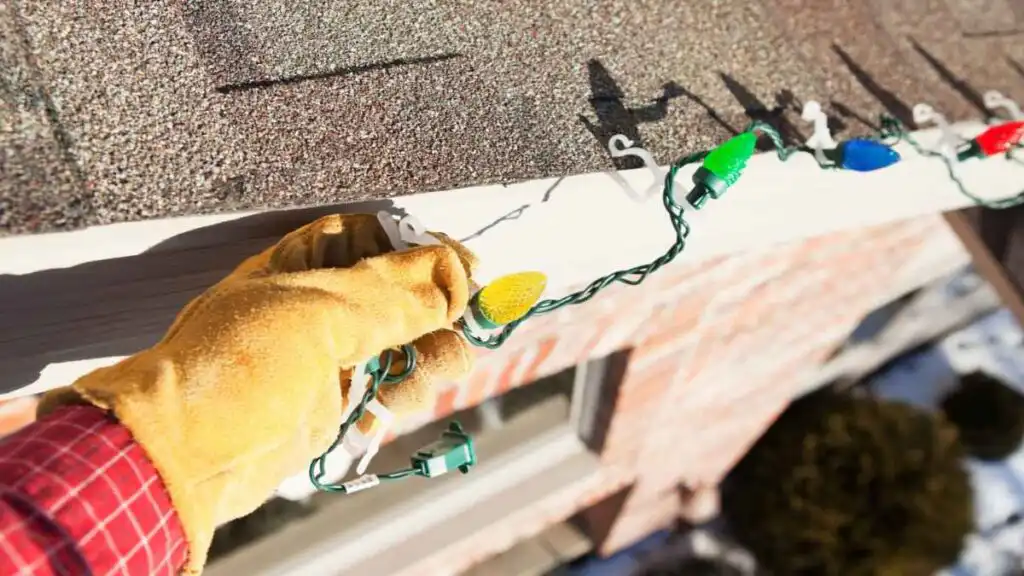
Plastic light clips are designed for this job, and there’s a style for almost every surface:
- Gutter clips hook over the front lip of the gutter.
- Shingle tabs slide gently under the edge of a shingle.
- Brick clips or outdoor-rated adhesive hooks work on masonry and siding.
Shingle tabs need a light touch on cold mornings. Asphalt shingles get stiff when temperatures drop, and they can crack if they’re pried up too hard.
Before anything gets clipped to the gutters, make sure they’re clear of leaves and firmly attached. Lights hanging on a gutter full of wet debris add one more thing pulling on a system that’s already struggling to drain.
Try the Ladder Test
Before deciding whether this is a DIY project, picture yourself installing the highest section of the roofline.
Then ask a few honest questions:
- Can the ladder sit on firm, level ground below that section?
- Can you reach the gutter without standing on the top rungs?
- Can you clip the lights without leaning outside the ladder rails?
- Will someone be there to hold the ladder?
- Can the whole job be done without walking on the roof?
If the answer is yes across the board, the project is probably manageable.
If any answer is no, that section deserves a second thought. Falls are the most common way holiday decorating goes wrong, and according to the U.S. Consumer Product Safety Commission, nearly half of holiday decorating injuries involve falls.
Do Most of the Work on the Ground
The safest time on a ladder is the time you never have to spend there.
Plug in every strand and check it before it goes anywhere near the house. Broken sockets, frayed wire, and damaged plugs mean that strand belongs in the trash.
Then snap the clips onto the strand at the spacing you want. It’s much easier to do this on the driveway than twenty feet up.
When it’s time to climb, start at the outlet and work away from it. That way, the plug lands exactly where you planned. Use a fiberglass or wood ladder outdoors, since metal conducts electricity, and move it every few feet instead of reaching.
It feels slower. It’s also how ladders stay upright.
As you clip, keep the bulbs pointing the same direction, either straight up or straight out. That consistency is what makes a roofline look clean from the street.
When everything is up, check the display at dusk. Gaps and crooked runs are much easier to spot once the lights are on.
The Ground Matters Too
Most people check the ladder. Fewer check what the ladder is standing on.
Mold on a driveway, patio, or walkway can make ladder feet slide, especially after a cold, damp night. That’s not a decorating problem. It’s a footing problem.
If the concrete around the house is stained or slick, a fall pressure washing visit can clean it up before the lights go on, so it’s safer to work on and looks better once everything is lit.
A Common Situation for First-Time DIYers
Consider a homeowner who buys lights on a Saturday afternoon, hoping to have everything up by dinner.
They grab six boxes that look about right. The first run goes up fine. The second comes up four feet short. The only outlet is on the opposite side of the garage. By late afternoon, they’re stretching an indoor extension cord across the lawn and trying to finish before dark.
Nothing about that day was unusual. It’s simply what happens when the hanging starts before the planning.
The same homeowner, with measurements, a power plan, and pre-clipped strands, would likely have finished in half the time with fewer trips up and down the ladder.
When DIY Makes Perfect Sense
Not every home needs professional installation.
A single-story ranch with a straight gutter line, easy outlet access, and level ground is a very manageable weekend project for most homeowners. If you’re comfortable on a ladder and have a helper, there’s no reason not to do it yourself.
The situation changes when the job involves walking on the roof, working on a steep pitch, setting a ladder near power lines, or spending long stretches high off the ground.
That’s where professional Christmas light installation becomes the better choice. At Castellan Pro Wash, we use commercial-grade LED lights custom-cut to fit your rooflines, so there are no bunched-up ends at the corners. We attach them with non-damaging clips, without drilling holes or using nails, to protect your shingles, gutters, and trim.
If a bulb burns out during the season, we come back and fix it at no additional charge. With our leasing program, you don’t have to buy or store lights, and you can change colors from year to year. When the holidays are over, we take them down too.
Frequently Asked Questions
Can I hang Christmas lights without nails?
Yes. Plastic gutter clips, shingle tabs, and brick clips hold lights securely without putting holes in your home.
Do outdoor Christmas lights need a GFCI outlet?
They should be plugged into one. If your outlet isn’t protected, a portable outdoor GFCI is a simple solution.
When is the best time to hang Christmas lights?
A dry, mild day in November is ideal. Waiting until the coldest weeks of December makes shingles more brittle and ladder rungs slicker.
Should I use LED or incandescent lights outside?
For most homes, LEDs are the better choice. They use less power, stay cooler, and let you run more strands on one circuit.
What if I’m not sure whether to DIY or hire a pro?
Try the ladder test above. If any section requires roof walking, overreaching, or working near power lines, reach out to us at Castellan Pro Wash and we’ll help you figure out the right approach for your home.
Plan First, Then Climb
If your roofline is simple and easy to reach, a little planning can turn holiday lighting into an enjoyable weekend project. If your home is taller, steeper, or harder to access, it’s worth letting someone else handle the ladder work. Either way, the best displays start the same way: measured, planned, and installed without damaging the house.
Not sure which approach makes sense for your home? Castellan Pro Wash can take a look at your roofline and help you plan a holiday display that looks great in O’Fallon, St. Charles, and the surrounding communities, so you can enjoy the season from the driveway. Contact us now for a free quote.
We invite you to check out our reviews on our GBP.